Translate Audio German to English: Pro AI Workflows 2026
Prepare the audio, pick the right language settings, fix the names and stiff phrasing the model gets wrong, then export subtitles or call the API.
13 min read
•
March 31, 2026
Written by
Adrian Ispas
To get your German audio translated into English, you need more than just a tool—you need a workflow that’s fast, precise, and secure. Modern AI can hit 95%+ accuracy and deliver results almost instantly, which is a game-changer for any professional who can’t afford mistakes or delays. Let's walk through how to set up a reliable process that works for any scenario.
Why Getting German to English Audio Translation Right Is a Big Deal
In a world this connected, translating audio from German to English isn't just a nice-to-have; it's a core business function. If a journalist is transcribing an interview with a German official, one wrong word can twist the whole story. A legal team reviewing evidence from a German court? They need absolute precision. There's just no room for "close enough."
This is especially true in fields like:
- Broadcasting and Media: News outlets and content creators have to subtitle German press conferences, interviews, and documentaries on tight deadlines for their global audiences.
- Legal Services: Law firms working on international cases rely on perfect, word-for-word translations of depositions, court hearings, and client calls.
- International Customer Support: Global companies need to make sense of customer feedback from German-speaking markets to actually improve their products and services.
The Trouble With Outdated Methods
For years, the only real option was to hire a human translator. That whole process is just riddled with problems. It's painfully slow, with projects taking days or even weeks to come back, and the cost can be staggering, especially if you have a lot of audio.
Even with the best intentions, human translators get tired. Fatigue leads to errors, which can completely undermine the integrity of the final transcript.
Practical Example: Imagine a marketing team needing to analyze feedback from a German focus group. With manual translation, they might wait a week for the transcripts. By then, the market opportunity they were discussing could be gone. AI delivers the same translated feedback in minutes, allowing them to act immediately.
This is where AI makes all the difference. The demand for better solutions is huge—Germany's language services market is already a €1.25 billion industry, making up 19% of the entire EU translation market. And it's shifting to tech, fast. The Germany Language Translation Software Market, which was valued at USD 5.4 billion in 2024, is expected to hit USD 9.7 billion by 2035. You can learn more about these market dynamics and what's driving this growth.
AI platforms like Vatis Tech are built to solve these exact problems. By offering 95%+ accuracy, automatic speaker identification, and serious security protocols (like GDPR and ISO 27001 compliance), they provide an alternative that's faster, more reliable, and far more secure. You can finally translate German audio into English and trust that every single word is captured just right.
Your Workflow For Flawless German Audio Translation
To get a great translation from German audio to English, you need more than just a tool—you need a reliable process. A solid workflow is what separates a one-off success from consistently accurate results, whether you’re translating a single interview or churning through hours of media broadcasts.
Let's break down the practical steps to turn this complex task into something you can nail every time.
Scenario: You're on a media monitoring team and a critical German news broadcast just aired. You need to quickly get the gist of it and fire off the key insights to your English-speaking colleagues. An efficient workflow isn't just nice to have; it's everything.
Step 1: Prepare Your Audio File First
The old saying "garbage in, garbage out" has never been more true. The quality of your source audio is the single biggest factor in your final translation's accuracy. An AI can’t translate what it can’t clearly hear, so running a quick quality check before you upload anything is non-negotiable.
This pre-flight check is your best defense against most common transcription errors. I’ve seen it countless times: a faint voice trying to compete with loud street noise results in a garbled transcript and a translation that’s complete nonsense. A few minutes of prep work here will save you hours of painful editing later.
To make this crystal clear, I put together a checklist to show exactly what to look for when preparing your files.
Audio File Preparation Checklist For Optimal Translation
Use this checklist to prepare your German audio file and ensure the highest possible transcription and translation accuracy.
| Checklist Item | Why It Matters | Quick Tip |
|---|---|---|
| Reduce Background Noise | Things like café chatter, wind, or room echo can easily confuse the AI, tanking your transcription accuracy. | Use a free tool like Audacity to run a noise reduction filter. It's a quick step that makes a huge difference. |
| Ensure Clear Speakers | Muffled or distant voices are a recipe for missed words. The AI needs a strong signal to work with. | Make sure the main speakers are noticeably louder than everything else. If you can, use a lavalier mic during recording. |
| Use a High-Quality Format | Heavily compressed formats like MP3 can strip out important audio data. Lossless formats give the AI more detail to analyze. | Always try to export or save your audio as a .WAV or .FLAC file. This is the pro move for getting the best results. |
Following this checklist moves your audio from "good enough" to "great," setting the stage for a much cleaner translation.
Step 2: Select The Right Translation Settings
With your audio prepped and ready, it's time to configure your translation tool. In a platform like Vatis Tech, you’ll upload your file and tell the AI exactly what to do. This is where you set the source language to German and then enable the translation feature, choosing English as the target.
But the real magic happens in the advanced settings. This is what separates a basic attempt from a professional-grade workflow.
Here are a couple of features I always use for professional projects:
- Speaker Diarization: This is a lifesaver. It automatically figures out who is speaking and labels each line accordingly (
Speaker 1:,Speaker 2:, etc.). If you’re translating an interview with multiple people, this is absolutely essential for creating a transcript that’s actually readable. - Custom Vocabulary: Does your audio contain specific jargon, brand names, or niche acronyms? Think medical terms like "MRT-Befund" or specific legal phrases. Adding these to a custom vocabulary list teaches the AI to recognize and spell them correctly, which dramatically boosts accuracy. You can dive deeper into how this works by understanding the tech behind high-quality German speech-to-text.
From my experience, the difference between a basic and a pro workflow is right here. Taking an extra minute to turn on speaker diarization or add a few custom terms can easily cut your post-editing time in half.
This infographic gives a great visual of just how much more efficient an AI-powered process is compared to doing it all by hand.
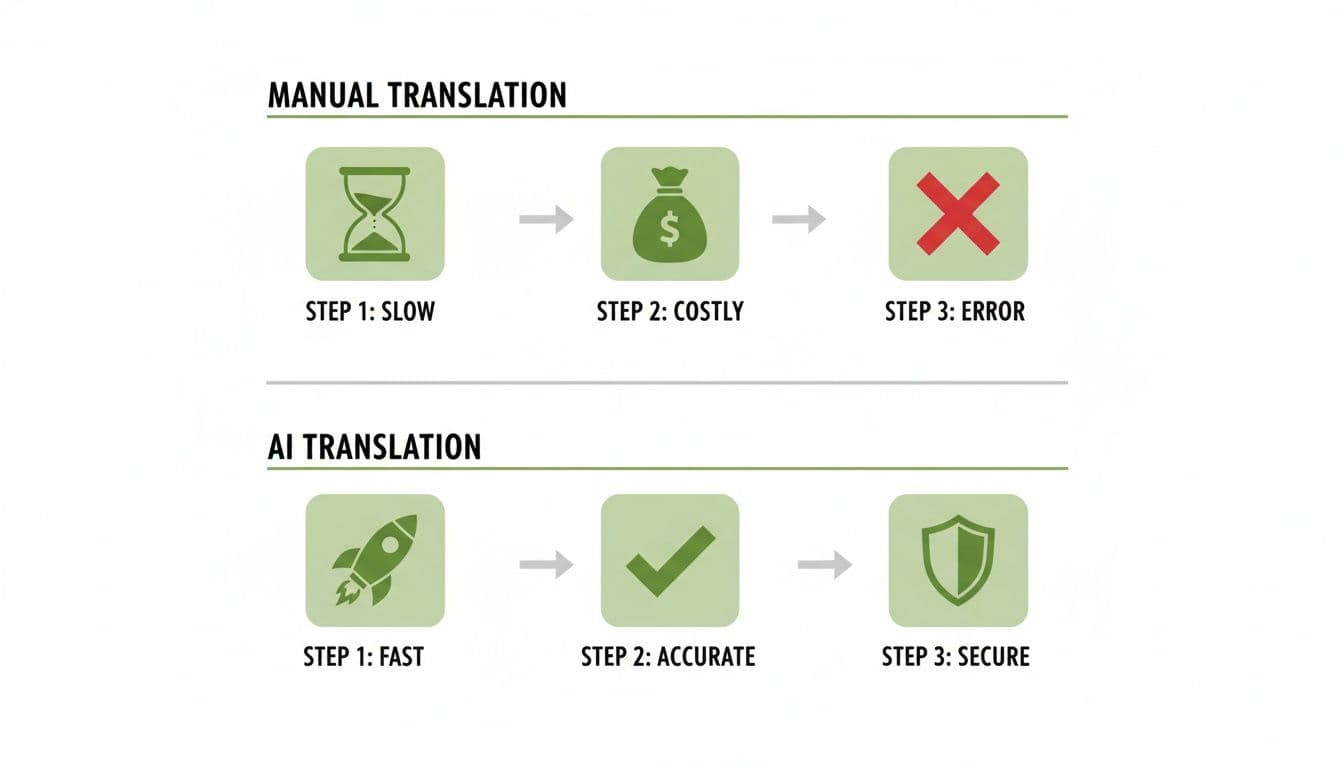
As you can see, AI workflows are not just faster—they deliver results that are more accurate and secure. For anyone looking to make this process even smoother, specialized hardware like the M8 Language Translator Earbuds can be a game-changer, offering real-time, two-way translation for a huge number of languages.
Step 3: How To Refine Your English Translation Like A Pro
An AI translation gets you most of the way there, but it’s that final human touch that makes all the difference. This is where you go from a technically correct translation to one that’s natural, accurate, and ready for a real-world audience. If you need to translate German audio to English for any professional purpose, this step is non-negotiable.
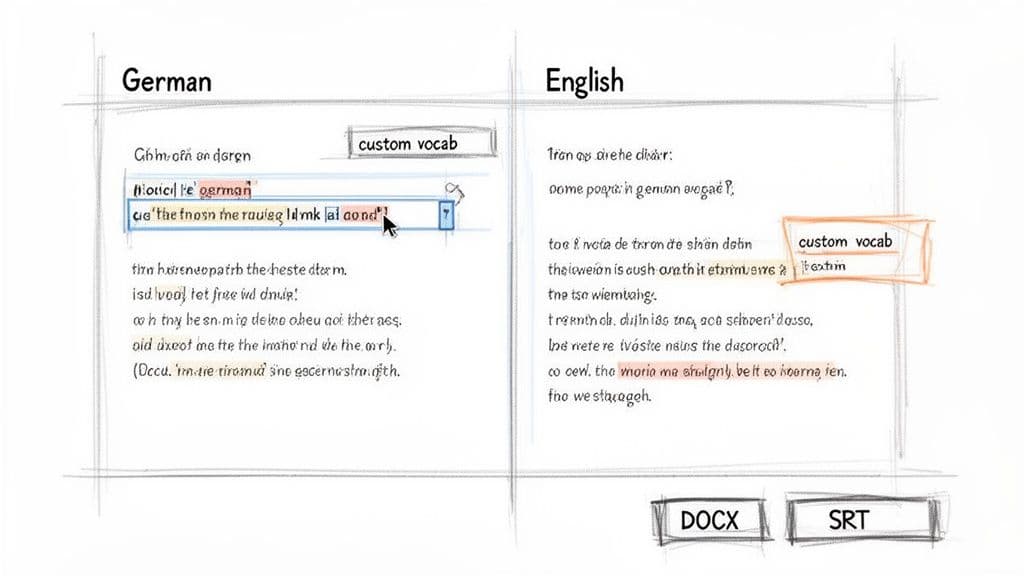
The best platforms for this have a side-by-side transcript editor. You get the original German transcription right next to the English translation, usually with synchronized timestamps. This setup makes it incredibly fast to spot discrepancies and polish the final text.
Common Issues To Spot And Fix
Your first editing pass should be all about catching the common mistakes AI makes. Even with 95%+ accuracy, a machine can easily stumble over cultural and linguistic nuances.
Here’s what to keep an eye on:
- Misspelled Names: AI often fumbles proper nouns, especially less common German names or specific company branding. A name like "Jürgen" might become "Jurgen," or a company like "Müller GmbH" could get garbled.
- Awkward Phrasing: Direct, word-for-word translations can sound robotic and stiff. Hunt for sentences that are technically correct but just don't feel right in English, then rephrase them for a smoother flow. For example, "I have hunger" becomes "I am hungry."
- Incorrect Punctuation: German and English have different punctuation rules. Watch out for misplaced commas or run-on sentences that need to be broken up for clarity.
This kind of refinement is absolutely critical in high-stakes fields. The market for precise speech-to-speech translation is booming, expected to jump from USD 0.76 billion in 2026 to USD 1.25 billion by 2031. This growth is fueled by industries like customer support, where accurate transcripts can cut documentation time by up to 80%. You can explore more data on the speech translation market to see how various sectors are tapping into this.
Practical Example: Imagine a doctor reviewing a translated patient visit. An AI might translate "MRT-Befund" as "MRT finding." A human editor immediately knows to correct this to "MRI report," ensuring the medical precision that a machine could easily miss.
Step 4: Exporting Your Final Product
Once you’re happy with the edits, it’s time to export your work. A professional-grade translation tool will give you several export options, each designed for a specific purpose.
| File Format | Common Use Case | Why It's Useful |
|---|---|---|
| DOCX | Creating detailed reports, meeting minutes, or legal documentation. | This format is universally editable and perfect for sharing text-based documents with colleagues who need to add comments or edits. |
| SRT/VTT | Adding subtitles or captions to video content for platforms like YouTube or Vimeo. | These formats include timestamps, ensuring your translated text syncs perfectly with the spoken audio in the video. |
| TXT | A simple, plain-text version for easy integration into other systems or for archiving. | TXT files are lightweight and compatible with nearly every application, making them ideal for raw data transfer. |
Picking the right format means your polished translation is ready to use right away, whether it’s for a formal report or for making your video content accessible. If video is your main goal, you might also want to look into a dedicated subtitle generator to make your captioning workflow even smoother.
Going Beyond Simple Translation: Advanced Tools for Professionals
Once you get past basic transcription and translation, you'll find a whole new layer of tools built for serious, demanding work. This is where AI stops being a simple converter and starts acting like a strategic part of your workflow, especially when you need to translate German audio into English for complex projects.
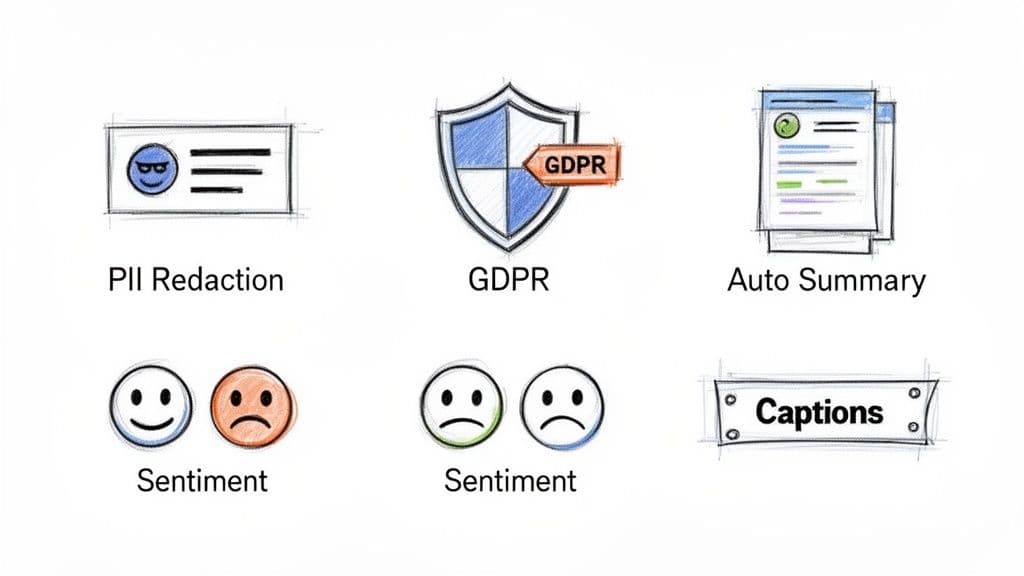
It's no surprise that these sophisticated features are becoming the norm. Germany's language services market is a massive €1.25 billion industry, and the global machine translation sector is exploding—projected to jump from USD 9 billion in 2026 to USD 23.53 billion by 2032. If you're interested in the data, you can find more market trend analysis here.
Keeping Sensitive Data Safe and Compliant
If you work in law or healthcare, you know that handling sensitive information isn't just a best practice—it's a legal requirement. This is where features like PII redaction are non-negotiable.
The AI automatically finds and scrubs personal data like names, addresses, or bank details from both the original German transcript and the English translation. This ensures everything stays compliant with strict regulations like GDPR.
Practical Example: A law firm is reviewing hours of German witness depositions. Instead of a paralegal spending days manually redacting documents, PII redaction anonymizes the files almost instantly, protecting witness privacy without the tedious labor and risk of human error.
Making Sense of Long Recordings in Minutes
Ever stared at a three-hour audio file, knowing the key insights are buried somewhere inside? Researchers and analysts deal with this all the time, drowning in hours of interviews, focus groups, and conference talks. AI-powered summaries and chapters are the answer.
- Auto-Generated Summaries: The AI gives you a quick, high-level overview of the entire recording, so you can get the gist in seconds.
- Auto-Generated Chapters: The transcript gets broken down into logical, timestamped sections with clear headings. This makes it incredibly easy to jump right to the parts you actually need to hear.
Practical Example: A market researcher analyzing German consumer feedback can use this to instantly find every mention of pricing without having to listen to two hours of unrelated chatter.
For anyone who works with huge volumes of audio, these organizational features are a total game-changer. What used to be a time-sucking manual process becomes a fast, strategic review. You get to spend your time analyzing, not just listening.
Uncovering Deeper Audience Insights
Sometimes, how something is said is just as important as what is said. The best tools can give you that crucial layer of context.
- Sentiment Analysis: This feature gauges the emotional tone—positive, negative, or neutral—in the original German audio. It's a quick way to measure customer satisfaction or public opinion at a glance.
- Topic Detection: The AI automatically tags the key subjects being discussed. This helps you organize and categorize feedback, especially when you're dealing with a high volume of it.
Practical Example: For a customer support team, this means you can immediately see if the feedback from your German-speaking customers is trending positive or negative and pinpoint exactly what's driving those feelings, like a recurring bug or a much-loved feature.
If you’re a content creator, understanding these nuances is what separates good content from great content. Making your work accessible is also key, which is why even platforms like YouTube's auto-translate feature are becoming essential for reaching a global audience.
Integrating German Audio Translation With An API
For developers and product teams, this is where the real magic happens. Moving beyond manual uploads and web interfaces, you can integrate German-to-English translation directly into your applications using an API. This is how you build truly scalable solutions, from internal business intelligence tools to global media platforms that translate content on the fly.
APIs typically handle translation in two main ways: asynchronous (file-based) processing and real-time (streaming) translation. With file-based translation, you send an entire audio file and get the complete transcript back. Streaming, on the other hand, processes audio as it arrives, which is essential for live events or communication apps where every second counts.
Configuring Your First API Call
Making your first API call to translate German audio is surprisingly direct. You’ll just need to configure a few key parameters that tell the system what you want to do.
For instance, using Python with the Vatis Tech API, you’d set the source language to de and enable translation to en. It’s that simple.
# Example API Call Snippet
import requests

api_url = "https://api.vatis.tech/v1/jobs"
headers = {"Authorization": "Bearer YOUR_API_KEY"}
payload = {
    "file_url": "YOUR_AUDIO_FILE_URL",
    "language": "de",
    "translate_to": "en",
    "speaker_diarization": True
}

response = requests.post(api_url, headers=headers, json=payload)
print(response.json())
The API documentation gives you a clear picture of all the parameters you can tweak.
As you can see, you can define not just the languages but also powerful features like speaker diarization and custom vocabulary. This allows you to automate the same professional-grade workflows we talked about earlier, but on a massive scale.
You can even bake in critical compliance features like PII redaction directly through the API. Just set the pii_redaction flag to true, and the system will automatically scrub sensitive data from your transcripts. This is a non-negotiable for anyone working in regulated fields like healthcare or finance.
If you want to dig deeper into the nuts and bolts, you can explore the full capabilities of a modern speech-to-text API.
The Strategic Advantage of API Integration
Using an API isn't just about making things faster; it’s about unlocking capabilities that would otherwise be out of reach. One of the biggest wins is unlimited concurrency. You can process thousands of audio streams or files at the same time without creating a bottleneck—a must-have for large-scale media monitoring or enterprise-level contact center analytics.
From a development standpoint, an API gives you complete freedom. You’re no longer stuck inside a pre-built interface. You can build your own speech-enabled products, design custom data dashboards, and feed translated insights directly into the tools your team already relies on.
For real-time use cases, the technology has come a long way. Research shows that modern end-to-end models can deliver speech-to-speech translation with a delay of just 2 seconds. This is the kind of low latency that makes live, cross-language conversations feel natural and opens up entirely new possibilities for global communication.
Common Questions About German Audio Translation
When you start translating German audio, a few questions pop up time and time again. You're probably wondering about accuracy, what to do with regional dialects, and whether your sensitive files are secure. Let’s get you some straight answers.
The first thing everyone asks is, "How accurate is it, really?" Modern AI can hit 95%+ accuracy, but that number comes with a big asterisk. It all depends on your audio quality. If you feed the AI a clean recording with clear speakers and no background chatter, you’ll get fantastic results.
But what about German dialects? Can an AI tell the difference between standard Hochdeutsch and a thick Bavarian (Bairisch) or Swabian (Schwäbisch) accent? The short answer is yes, but with some nuance. Most systems are trained on Standard German, so while they’re getting much better at understanding regional variations, you might see a slight dip in accuracy compared to standard speech.
Choosing The Right File Format
People often get stuck on which audio file to upload. It’s a valid concern—the quality of your source file directly impacts the final translation.
- For the best possible results: Always use a lossless format like WAV or FLAC. These are the uncompressed, raw versions of your audio, giving the AI the maximum amount of data to work with.
- For everyday convenience: Compressed files like MP3 work just fine. Just know that heavy compression can sometimes create small artifacts that might slightly reduce transcription accuracy.
Think of it like this: a WAV file is like a high-resolution RAW photograph, packed with detail. An MP3 is the compressed JPEG version. The more detail you give the AI, the sharper the final picture—or in this case, the translation.
Security And Data Privacy
"Is my data safe?" This is non-negotiable, especially if you're working with sensitive audio in the legal, healthcare, or corporate worlds.
Any reputable translation service will be upfront about its security and compliance. You should be looking for a platform that clearly states its policies and holds key certifications.
Here’s what to look for:
- GDPR: This ensures your data is handled according to the EU’s strict privacy laws.
- ISO 27001: This is a global standard for managing information security.
- End-to-End Encryption: This scrambles your data as it travels to and from the server, making it unreadable to outsiders.
Always double-check that your chosen provider offers these safeguards. Some top-tier platforms even provide features like PII (Personally Identifiable Information) redaction, which automatically finds and removes sensitive details from your transcripts. It's an extra layer of security that's essential for any confidential work.
Ready to translate your German audio with confidence? Vatis Tech provides the accuracy, security, and advanced features you need to get professional results every time. Start your free trial today and experience the difference.