Laws Regarding Recording Conversations: 2026 Guide
Which US states require all-party consent to record a conversation, what counts as consent, how interstate calls are treated, and the penalties for error.
12 min read
•
May 28, 2026
Written by
Adrian Ispas
A manager wants to keep a few standout support calls for training. A producer wants to record a remote interview before a source changes their mind. A sales leader wants every discovery call transcribed so coaching doesn't depend on handwritten notes. All three are dealing with the same question, and it's rarely as simple as "Can we record this?"
The core issue is that recording rules sit at the intersection of privacy law, workplace policy, and data handling. A call can be lawful to record in one setting and risky in another. A recording can be captured properly, then mishandled later when it's shared internally, pushed into a transcription tool, or exported into a case file or newsroom archive.
For teams that work across states, the practical risk is a false sense of simplicity. Someone hears "one-party consent" and assumes that's the whole rulebook. It isn't. The laws regarding recording conversations require managers to think through jurisdiction, consent, notice, storage, disclosure, and downstream use before anyone presses record.
The High Stakes of Pressing Record
A support team often starts with a harmless goal. Save good calls. Use them in onboarding. Build a library of examples so new hires can hear how experienced agents de-escalate complaints or explain billing clearly.
Then someone asks the question that should have been asked first: did the customer agree to being recorded for that purpose?
That question changes everything. Legal exposure doesn't only come from a secret recording made by a rogue employee. It can come from routine business habits. A supervisor records calls for quality assurance, then shares clips broadly. A newsroom records a phone interview with a source in another state. A founder records investor or candidate conversations and forwards transcripts around the company. In each case, the recording itself is only part of the risk.
Where teams usually get this wrong
The first mistake is treating recording as a feature instead of a regulated act. Zoom, Teams, dialers, mobile phones, and browser extensions make recording easy. Compliance doesn't become easier just because the button is easier to find.
The second mistake is stopping the analysis too early. Managers focus on whether they can capture audio, but they don't ask:
- Which law controls this conversation: The state of the caller, the recipient, the office, or more than one.
- What type of consent is required: One participant's consent or everyone's.
- How the recording will be used later: Training, evidence, QA review, media publication, or AI transcription.
- Who gets access afterward: Supervisors, vendors, contractors, or the entire team.
Practical rule: If your team can't explain why it is recording, who consented, and who will access the result, it isn't ready to record.
In practice, the safest organizations build one workflow for obtaining notice and documenting consent, then apply it consistently. What doesn't work is relying on individual judgment call by call. That's how teams end up with a mix of proper notices, informal assumptions, and recordings no one should have made.
One-Party Versus Two-Party Consent Explained
Consent is the core concept behind most laws regarding recording conversations. If your team understands this part clearly, the rest of the compliance work gets easier.
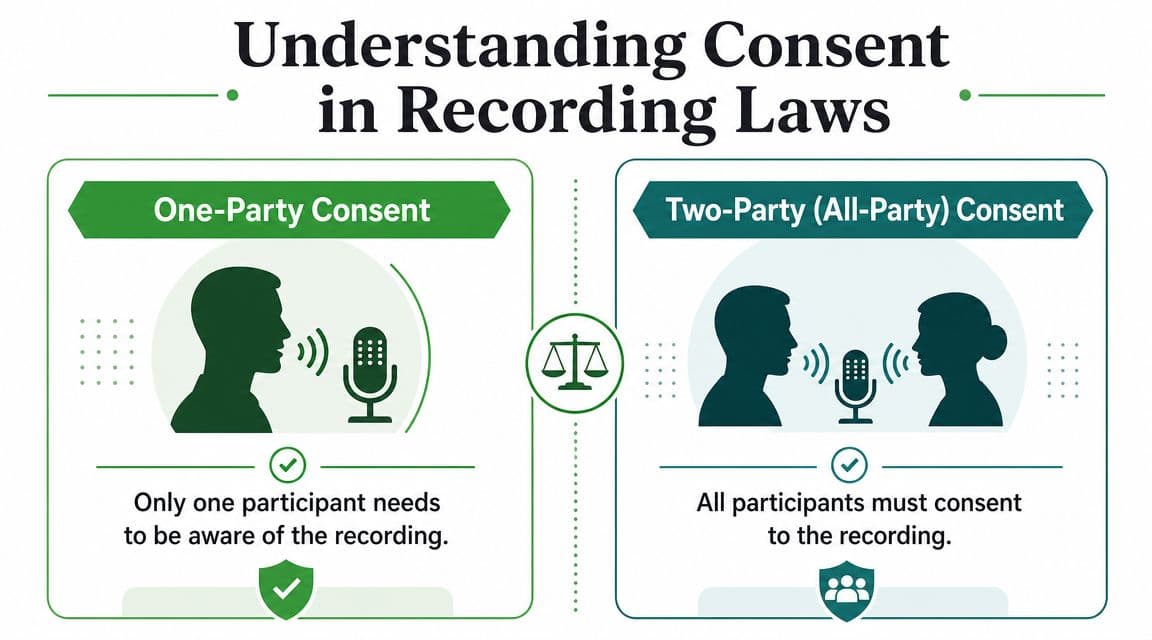
Use a simple photo analogy. In a one-party consent setting, one participant in the conversation can authorize the recording. In a two-party or all-party consent setting, every participant must agree before the recording begins. The term "two-party" is not limited to conversations involving precisely two individuals. On a conference call, it means all participants.
A quick visual helps:
What counts as consent
Consent can be clear and direct, such as a verbal "yes, you can record." It can also be built into a process, such as a meeting platform banner, a verbal disclosure at the start of a customer call, or a company policy acknowledged by employees. But teams often get sloppy at this point. A tool prompt isn't a substitute for a policy, and a policy isn't a substitute for checking whether the notice is effectively reaching participants.
For managers, the practical standard should be stronger than the legal minimum. Make the notice obvious. Make the timing early. Keep proof that it happened.
A straightforward script works better than legal jargon:
- Phone call script: "Before we continue, I want to let you know this call is being recorded for training and documentation. Are you okay to proceed?"
- Meeting script: "This meeting will be recorded and transcribed for internal notes. If anyone objects, say so now and we'll stop the recording."
- Interview script: "I'd like to record this conversation for accuracy. Do I have your permission to record?"
Privacy matters as much as consent
Not every sound qualifies as a protected private conversation. The law often turns on whether participants had a reasonable expectation of privacy. A private phone call from home usually raises stronger privacy expectations than casual background conversation in a crowded public setting.
That doesn't mean public space recordings are automatically safe. Teams still need to think about what is being captured, whether a person is the subject of the recording, and whether the conversation has shifted into a private exchange.
Consent isn't just a legal formality. It's also the cleanest operational control. If everyone knows the call is being recorded, fewer disputes arise later about whether the recording should exist.
For a short explainer in video format, this overview is useful before training staff:
Navigating Federal and State Recording Laws
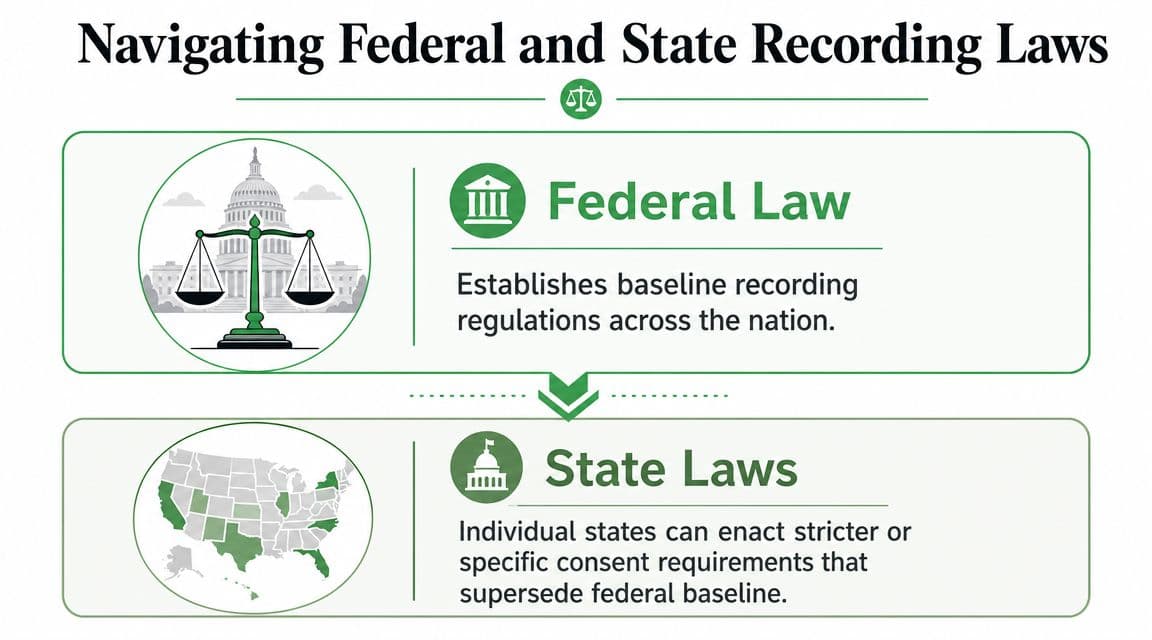
The legal structure works like a pyramid. Federal law creates the baseline. States can build stricter rules on top of it. Businesses get into trouble when they assume the baseline is the whole rule.
The federal floor
In the United States, the modern legal baseline is the federal Wiretap Act, codified at 18 U.S.C. § 2511, which generally prohibits intentionally intercepting wire, oral, or electronic communications but allows recording when at least one party has given prior consent. The same framework can carry criminal exposure of up to 5 years in prison, and 18 U.S.C. § 2520 also creates civil-damages liability, as summarized in Justia's overview of federal and state recording law.
That matters because many teams hear "federal law allows one-party consent" and stop there. A company can't rely on the federal baseline if a state imposes a stricter rule.
Why state law changes the answer
States can require broader consent than the federal default. That's why a business based in a state with stricter rules can't point to federal law and move on. The more distributed your workforce is, the less likely it is that one rule fits every call.
A few common business scenarios create risk fast:
| Scenario | Why it's tricky | Safer approach |
|---|---|---|
| Remote employee calls customer in another state | More than one jurisdiction may matter | Use an all-party disclosure workflow |
| Manager records internal HR meeting | Employment policy may help, but privacy concerns remain | Give advance notice and limit access |
| Journalist interviews source across state lines | Reporting purpose doesn't erase consent rules | Confirm consent on the record before starting |
For teams building a formal policy, this guide to recording a phone conversation is a useful operational reference because it forces the practical question managers need answered: what should staff do before, during, and after the call?
The safest working rule
Interstate calls are where legal certainty drops and operational discipline has to rise. If people on the call are in different states, your team may not have a neat answer on which state's rule a court will prioritize.
The safest internal policy is usually the strictest one your calls are likely to trigger:
- Disclose recording at the start
- Obtain affirmative consent when possible
- Document that consent
- Stop recording if any participant objects
That approach may feel conservative, but it scales better than trying to teach frontline staff a maze of exceptions.
A State-by-State Guide to Consent Requirements
Managers need a quick reference, not a law school seminar. The table below is best used as a first-pass operational tool. Before your team relies on it for a workflow, verify current state law with counsel, especially for interstate calls, in-person conversations, and sector-specific rules.
Quick-reference table
| State | Consent Type |
|---|---|
| Alabama | One-party |
| Alaska | One-party |
| Arizona | One-party |
| Arkansas | One-party |
| California | All-party |
| Colorado | One-party |
| Connecticut | Situational |
| Delaware | All-party |
| Florida | All-party |
| Georgia | One-party |
| Hawaii | One-party |
| Idaho | One-party |
| Illinois | All-party |
| Indiana | One-party |
| Iowa | One-party |
| Kansas | One-party |
| Kentucky | One-party |
| Louisiana | One-party |
| Maine | One-party |
| Maryland | All-party |
| Massachusetts | All-party |
| Michigan | Situational |
| Minnesota | One-party |
| Mississippi | One-party |
| Missouri | One-party |
| Montana | All-party |
| Nebraska | One-party |
| Nevada | Situational |
| New Hampshire | All-party |
| New Jersey | One-party |
| New Mexico | One-party |
| New York | One-party |
| North Carolina | One-party |
| North Dakota | One-party |
| Ohio | One-party |
| Oklahoma | One-party |
| Oregon | Situational |
| Pennsylvania | All-party |
| Rhode Island | One-party |
| South Carolina | One-party |
| South Dakota | One-party |
| Tennessee | One-party |
| Texas | One-party |
| Utah | One-party |
| Vermont | Federal default applies |
| Virginia | One-party |
| Washington | All-party |
| West Virginia | One-party |
| Wisconsin | One-party |
| Wyoming | One-party |
| District of Columbia | One-party |
How to use the table without creating new risk
A table like this helps with triage, not final legal signoff. The problem states are the ones marked situational. Those are the places where distinctions such as phone versus in-person recording, private versus public conversations, or statutory text versus court interpretation can matter.
For managers, the easiest internal rule is often more useful than the most technical legal explanation:
- If the call crosses state lines, treat it as higher risk.
- If any participant is in an all-party or situational state, use an all-party consent workflow.
- If the recording involves HR, legal, healthcare, or sensitive customer data, tighten access and retention.
If your frontline staff need a state chart to make a decision in real time, your policy is too fragile. Give them a default script and a clear escalation path.
A practical rule of thumb for interstate calls
If your employee is in Texas and the customer is in California, don't ask the employee to guess which law a dispute might end up under. Require the employee to disclose the recording and get clear agreement before continuing.
That approach won't solve every legal nuance, but it prevents the most common business failure: acting as if the caller's local rule is the only one that matters.
Important Exceptions and Special Scenarios
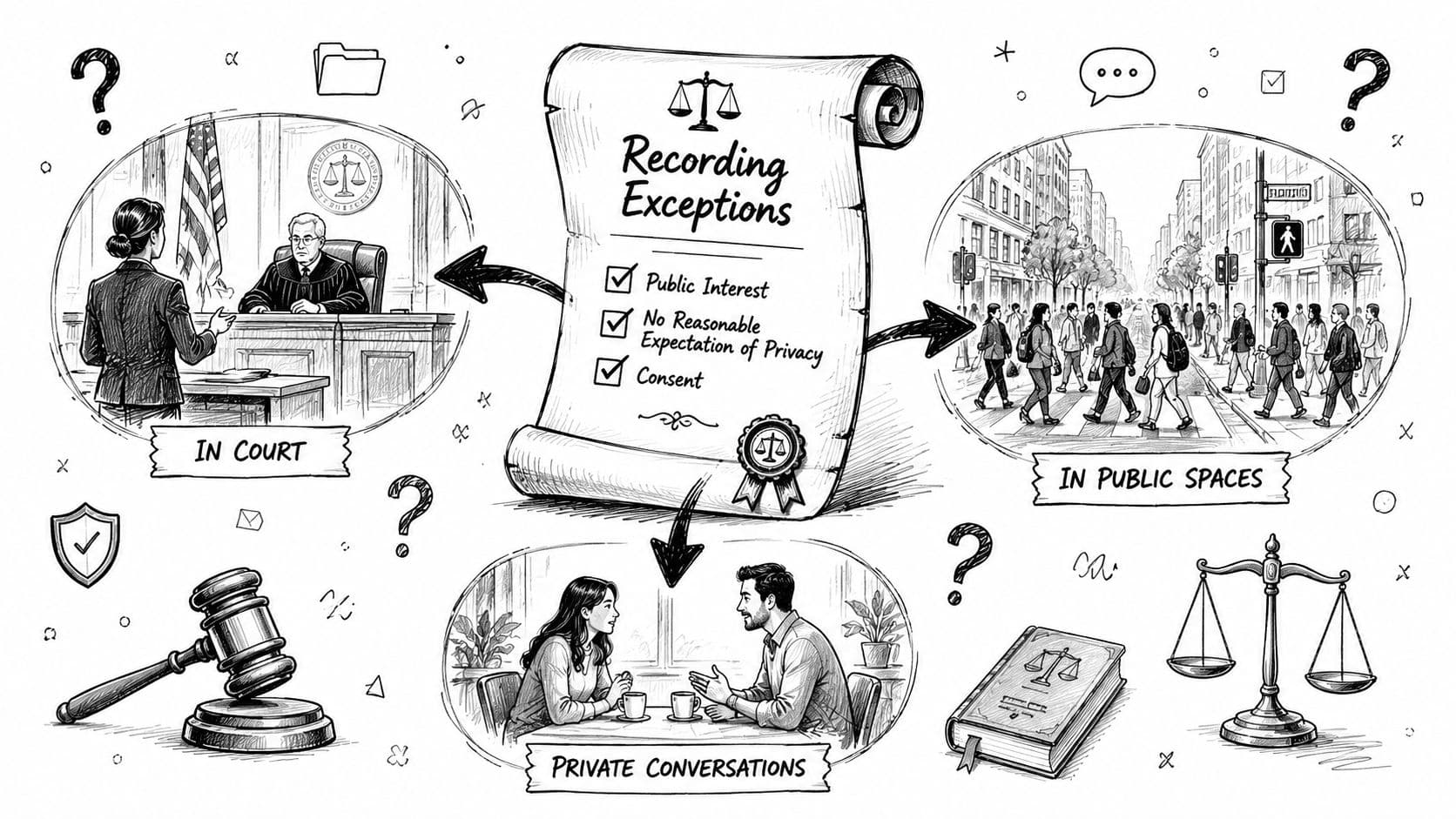
Most recording disputes don't arise in textbook conditions. They arise in borderline situations where a team assumed an exception applied and never checked the limits.
Public settings and privacy expectations
A conversation in a busy park, trade show floor, or hotel lobby doesn't carry the same privacy expectation as a closed-door office call. That's why public setting recordings are often analyzed differently.
But managers should be careful here. "Public place" doesn't mean "anything goes." If two people step away from the crowd and speak softly, the facts can start looking more like a private conversation than ambient public noise.
A practical newsroom or field-team rule works well: if your recording centers on a specific person rather than general surroundings, get permission unless you have a clear reason not to and counsel has approved the practice.
Workplace monitoring and employee notice
Employers often assume internal calls are easier to record because they own the systems. That assumption only gets you part of the way. System ownership doesn't erase privacy law or employment risk.
What helps is a clean policy structure:
- Written handbook language: State that certain business communications may be monitored or recorded.
- Acknowledgment process: Require employees to sign or electronically acknowledge the policy.
- Purpose limits: Tie recording to training, security, QA, or documentation, not open-ended surveillance.
- Access controls: Restrict who can review the recordings.
An employee handbook can support notice and internal expectations. It does not fix a bad workflow with outside customers, candidates, vendors, or interview subjects.
Customer service disclosures
The familiar phrase "This call may be recorded for quality assurance" exists for a reason. Done properly, it gives notice before the substantive conversation begins and creates a clear moment for the other party to decide whether to continue.
What works in practice is consistency. The disclosure should fire every time, at the start, before sensitive details are discussed. What doesn't work is relying on agents to remember the script only on some calls.
A recorded disclaimer is only as good as the process behind it. If the notice starts late, fails on transferred calls, or isn't preserved in the call log, your compliance story gets weaker.
Three operational checks catch most failures:
| Scenario | Good practice | Weak practice |
|---|---|---|
| Inbound service line | Automated notice before agent discussion | Notice added halfway through the call |
| Outbound sales call | Rep states recording notice immediately | Rep waits until after discovery questions |
| Internal review meeting | Calendar notice plus verbal reminder | Assumption that everyone "already knows" |
From Lawful Recording to Secure Transcription
Consent gets you to the starting line. It doesn't answer what your organization can do with the recording afterward.
That gap matters more now because recordings are rarely left alone as audio files. Teams send them into transcription platforms, summarize them with AI, search them by keyword, clip excerpts for training, and export transcripts into CRMs, HR folders, legal files, and content systems. A conversation that was hard to replay becomes easy to copy, edit, and redistribute.
According to the Reporters Committee guide on California recording law, a major gap in common explainers is what happens after a recording is lawfully captured, especially retention, disclosure, and evidentiary use. That matters because California law is especially nuanced about intentional disclosure of private telephone conversations obtained in violation of wiretap law, and many summaries don't separate recording legality from later sharing, storage, or transcript export.
Consent records need to travel with the file
A recording without context becomes a compliance problem fast. If your team stores audio or transcripts, the file should carry enough metadata to answer basic questions later:
- Who consented: Names or participant identifiers
- How consent was obtained: Verbal, written, platform notice, policy acknowledgment
- When the notice was given: Before recording began
- Why the recording exists: QA, training, legal documentation, interview accuracy, internal notes
- Who may access it: Specific teams or roles
AI transcription programs hold the potential to either reduce risk or multiply it. A secure workflow limits who can upload files, where transcripts are stored, and whether personal data is redacted before broader sharing.
For teams comparing storage and transfer controls, FaxZen's secure communication overview is a useful primer on why encryption matters once voice recordings and transcripts start moving between systems.
A practical post-recording workflow
The strongest programs treat audio and transcripts as governed records, not convenience files.
- Capture consent evidence early
Save the spoken consent in the recording itself when possible. For recurring workflows, keep logs from phone systems, meeting platforms, or acknowledgment tools. - Classify the content
A customer complaint, an employee relations conversation, and a media interview shouldn't all follow the same access rules. - Transcribe inside a controlled environment
If your team uses AI transcription, prefer tools that support permission controls, encryption, and data handling features that fit your environment. One example is Vatis Tech's guide to transcribing audio to text, which is relevant for teams operationalizing transcription after lawful capture. - Limit sharing of transcripts
Text is easier to forward than audio. That's exactly why transcript access should usually be narrower, not broader.
The compliance mistake isn't only secret recording. It's lawful recording followed by casual distribution.
The organizations that handle this well don't ask only, "Did we have consent to record?" They also ask, "Who approved retention, where is the transcript stored, and who can export it?"
Your Compliance Checklist and a Warning on Penalties
Managers need a repeatable process. The checklist below is the version I would want a support leader, newsroom editor, or operations manager to keep next to the recording policy.
The checklist
- Map the jurisdiction first
Identify where each participant is located and whether the call crosses state lines. - Apply the stricter consent workflow when in doubt
If any participant may be subject to an all-party or situational rule, use clear notice and obtain agreement before recording. - Document the consent event
Keep the verbal consent in the audio when practical, and preserve platform logs or policy acknowledgments. - Control the downstream use
Decide in advance whether the recording is for QA, training, evidentiary support, journalism, or internal notes. Don't let staff improvise later uses. - Protect the files and transcripts
Restrict access, define retention, and make sure vendors handling recordings are covered by appropriate contractual and security terms. If your team is reviewing vendor obligations, Vatis Tech's data processing agreement information is the kind of reference worth checking alongside your own procurement process. - Train the people who press record
Policies fail when legal writes them and frontline teams never absorb them.
For contact center leaders trying to operationalize this inside QA and customer support workflows, CallZent compliance solutions offers a practical view of the controls teams usually need around disclosures, call handling, and oversight.
Why the penalties deserve attention
This isn't a low-stakes paperwork issue. Under the federal framework discussed earlier, unlawful interception can carry criminal exposure of up to 5 years in prison and can also trigger civil liability. State law can add its own consequences. Even when a dispute never turns into a prosecution, a bad recording practice can still create litigation risk, employee claims, customer complaints, and evidence problems.
The best compliance outcome is usually boring. A standard notice. A documented yes. A secure transcript. Limited access. That's what you want.
If your team records calls, interviews, meetings, or support conversations and needs a cleaner workflow from consent to transcript handling, Vatis Tech can fit into that process as a speech-to-text platform with features like speaker identification, timestamps, export controls, and enterprise deployment options. The legal decision to record still belongs to your organization, but the way you handle audio and transcripts afterward should be just as disciplined.