Standout Resumes for Journalists: 2026 Guide
Editors give a resume about six seconds. How to fit journalism experience on one page, write bullets with real metrics, and place the portfolio link.
12 min read
•
May 27, 2026
Written by
Adrian Ispas
You've got clips you're proud of. A city council scoop that moved the conversation. A clean explainer video. A newsletter that readers opened. Maybe a podcast segment you turned around on deadline with almost no time to breathe.
And still, your applications disappear into silence.
That usually isn't a talent problem. It's a packaging problem. Strong reporting often gets buried inside weak resumes for journalists because the document reads like a job log instead of an argument. Hiring editors don't need a full archive of your career. They need fast proof that you can do the job they're filling, in the format they care about, with evidence they can verify.
A modern journalism resume isn't just a history of where you worked. It's a selective case for why you should get the interview.
Why Your Great Stories Aren't Landing You Interviews
I've seen this pattern over and over. A reporter has real work behind them, but the resume opens with soft claims like “passionate storyteller” or “hardworking multimedia journalist.” Then it drops into vague bullets: covered local news, wrote articles, attended editorial meetings, worked under deadlines.
None of that is false. None of it helps enough.
Editors don't hire duties. They hire outcomes, judgment, range, and fit. If your best evidence lives in your clips, transcripts, visual packages, newsletters, or data work, but your resume never translates that into newsroom value, the document undersells you.
Your resume should read like a sharp pitch memo, not a staff directory entry.
The mismatch gets worse in hybrid roles. A newsletter writer may have excellent instincts for framing and audience service, but if the resume only lists article production, that person looks narrower than they are. A video journalist may have strong scripting and editing chops, but if the resume hides links to actual work, the hiring manager has to do extra digging. Most won't.
That's also why it helps to understand how automated filters and structured screening affect the first cut. If you want a grounded overview of that side of the process, this AI resume screening guide is useful context before you start revising.
The shift that gets interviews is simple. Stop asking, “What did I do in this job?” Start asking, “What proof would make an editor trust me fast?” For some people, that proof is bylines. For others, it's publication cadence, audience impact, transcript-linked audio, social video, visuals, or cleanly presented data outputs.
Mastering the Six-Second Scan and the One-Page Rule
Journalism hiring is brutal on clutter. If your resume takes effort to decode, it loses.
NBCU Academy says recruiters may spend about six seconds on an initial resume scan, and that's why the standard advice for journalists with less than a decade of experience is to keep the resume to one page and focus on 3 to 5 bullet points per role in that limited space, as summarized in this NBCU Academy resume guidance video.
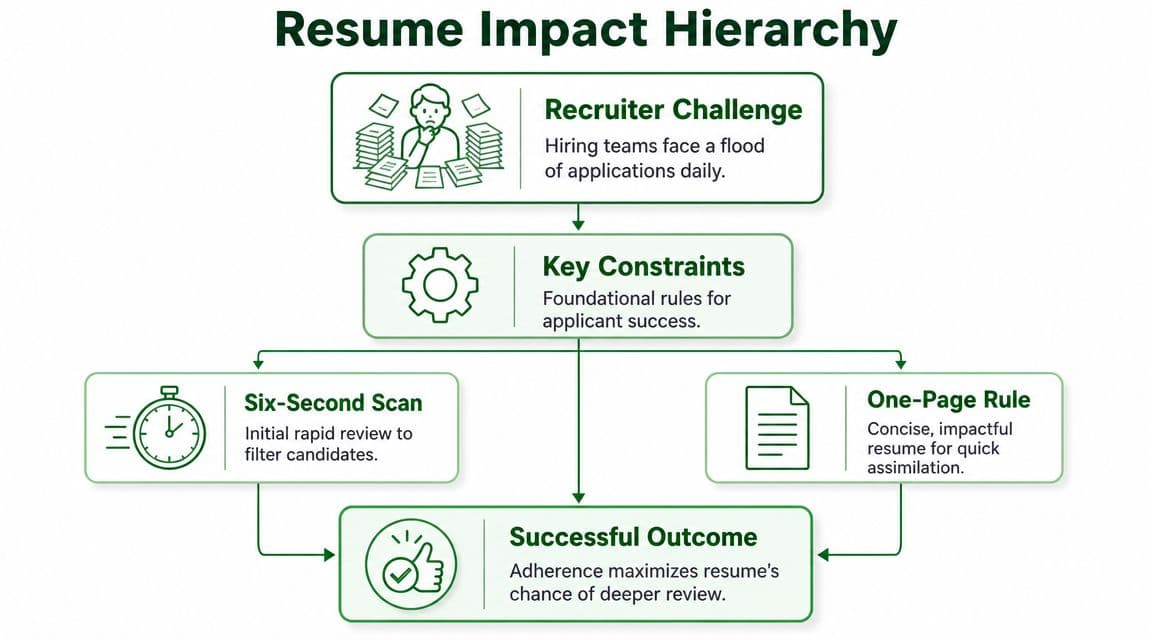
What the editor sees first
The first scan isn't deep reading. It's pattern recognition. A hiring editor is looking for signs that answer a few immediate questions:
- Role fit: Does this person look like a reporter, producer, editor, or data journalist for this opening?
- Recency: Is the experience current and easy to follow in reverse chronological order?
- Signal strength: Are the top bullets accomplishment-heavy, or are they stuffed with routine tasks?
- Practical skills: Can this person handle the tools, formats, and workflows this newsroom uses?
If your strongest proof starts halfway down the page, you've already made the job harder than it needs to be.
The one-page rule is a filter, not a punishment
Most early-career applicants don't have a one-page problem. They have an editing problem.
Keep one page if your experience is still consolidating. That forces you to prioritize the work that directly matches the role. If you've held several internships, student media roles, freelance assignments, and part-time newsroom jobs, don't give each one equal weight. The newsroom doesn't care equally about each one.
Use this simple structure:
- Name and contact block with portfolio link.
- Summary that states your journalism lane clearly.
- Skills grouped by relevant categories.
- Experience in reverse chronological order.
- Education and selected awards or affiliations if they help.
Practical rule: If a line doesn't help a hiring editor imagine you doing this job soon, cut it.
Make the page easy to scan
Design matters, but not in the way many applicants think. Fancy layouts often weaken resumes for journalists because they interrupt reading flow.
Use:
- Clear hierarchy: Larger name, obvious section headings, consistent spacing.
- Readable typography: A plain, professional font.
- Tight bullets: Short enough to skim, specific enough to matter.
- Chronology that behaves: Employer, title, location, and dates should be effortless to find.
If you want examples of modern layout choices without drifting into overdesigned templates, this guide to 2026 resume formats is a solid reference point.
A journalism resume should feel like a clean front page. The important story is visible immediately.
Writing a Headline-Worthy Summary and Skills Section
The top third of your resume does most of the persuasion. Waste it, and the rest of the document has to work too hard.
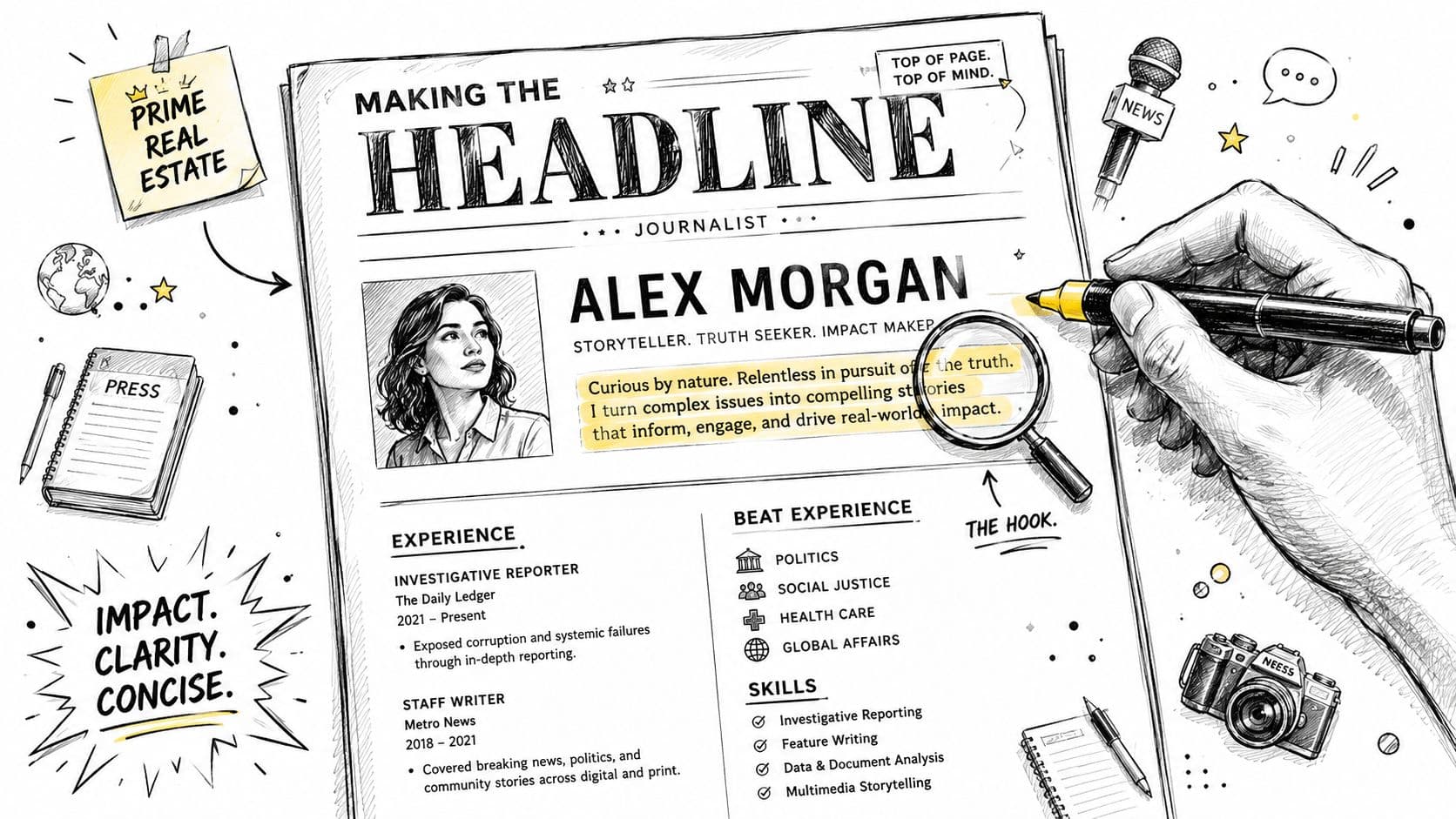
Write the summary like a lede
Your summary should identify you fast. Not with personality fluff, but with role, specialization, and evidence.
Bad summary:
- Multimedia journalist with strong communication skills and a passion for storytelling.
Better summary:
- City government reporter with experience covering public meetings, breaking news, and enterprise features across digital and video formats. Strong clip portfolio in accountability reporting, quick-turn web copy, and source-driven beat coverage.
That second version works because it names a lane. It also gives the editor a reason to keep reading.
A strong summary usually does three things:
- Names your journalism identity such as courts reporter, audio producer, data journalist, newsletter editor, or photojournalist.
- Shows your working formats such as text, video, audio, live blogs, social, or data visualization.
- Signals what makes you useful such as beat depth, editing speed, source development, or technical workflow.
Build a skills section humans can scan
A weak skills section is just a pile of software names. A good one creates instant confidence.
Group skills by function so the reader can process them quickly:
- Reporting and editing: AP style, source development, fact-checking, copy editing
- Audio and video: Adobe Premiere Pro, Adobe Audition, field recording, scripting
- Publishing tools: WordPress, CMS workflows, headline testing, newsletter platforms
- Data and visuals: SQL, Python, OpenRefine, spreadsheets, charting tools
- Languages: Add only if they're professionally relevant
For data or investigative work, Columbia Journalism School's resume guide specifically highlights SQL, OpenRefine, Python/Pandas, and Jupyter as meaningful technical signals, and that guidance is still useful in practice because it points you toward concrete newsroom workflow tools, not generic “data skills,” in this Columbia Journalism School resume guide.
Match the job description without sounding synthetic
If the opening emphasizes transcripts, clips, and fast turnaround for interviews, reflect that language where it fits truthfully. Journalists who work in audio and video can also strengthen this section by linking supporting workflow evidence, especially if they regularly turn interviews into searchable text. A practical example is pairing your resume with a process you already use for interviews, such as this overview of transcription software for interviews.
A quick walkthrough can help if you're still tightening the structure and wording:
Your summary and skills section shouldn't try to tell your whole story. They should tell the editor what kind of journalist you are before they have time to guess.
Turning Responsibilities into Metric-Driven Accomplishments
Most resumes for journalists fall apart at this stage. They describe work. They don't prove value.
Current guidance for journalism resumes pushes in the same direction. PR Newswire advises candidates to include metrics and goals, and Indeed recommends 3 to 7 bullets per job entry that show quantifiable accomplishments rather than a list of daily tasks, as reflected in this journalism resume advice from PR Newswire.
Stop writing job descriptions
These bullets are common and weak:
- Covered education beat and wrote daily stories
- Produced social media content for newsroom accounts
- Assisted with podcast production
- Edited reporter copy under deadline
They describe activity, not impact. A hiring editor can't tell how well you did any of it.
Try this instead:
- Produced daily education coverage with a mix of breaking news and enterprise stories, including accountability reporting tied to district policy decisions
- Planned and published platform-specific social posts that extended the reach of breaking coverage and feature packages
- Booked guests, cut tape, and assembled episode materials for a recurring newsroom podcast, including show notes and transcripts
- Edited deadline copy for clarity, structure, and style consistency across fast-moving digital coverage
Notice the difference. Even without inventing numbers, these bullets show judgment, format, and output.
Use metrics where you genuinely have them
Not every newsroom role has clean dashboards available to you. That's fine. Use numbers you can verify and defend.
Good journalism metrics often include:
- Publication volume
- Deadlines met
- Newsletter sends
- Video packages completed
- Episodes produced
- Internships and employment dates
- Audience or engagement indicators you had access to
- Number of articles published, which Monster specifically identifies as a useful example of quantified achievement in journalism resumes, as noted in the earlier NBCU-linked guidance
If a number would make you nervous in an interview, don't put it on the page.
Before and after examples
Here are stronger rewrites that stay grounded:
| Before | After |
|---|---|
| Wrote articles for local news site | Published recurring local news and feature coverage on deadline, with clips selected to show beat range and reporting depth |
| Managed newsletter | Wrote and produced a recurring newsletter, shaping story selection, subject framing, and audience-facing copy |
| Helped with video | Shot and edited short news videos, pairing script writing with platform-ready packaging |
| Worked on investigations | Supported investigative reporting through document review, source research, and data organization |
Journalism resume metrics by role
Use this table as a prompt list when you revise your bullets.
| Role | Metric to Track | Example Bullet Point |
|---|---|---|
| Reporter | Number of articles published | Published a steady volume of beat stories and enterprise pieces, with clips selected to show breaking news speed and source-based reporting |
| Newsletter writer | Audience growth or conversion rates | Produced newsletter editions that translated daily reporting into audience-focused copy and measurable subscription value |
| Broadcast producer | Segments or packages completed | Produced recurring segments from booking through script refinement and rundown coordination under tight deadlines |
| Photojournalist | Published galleries or assignments completed | Delivered photo coverage for breaking news and feature assignments, with portfolio links highlighting range and consistency |
| Data journalist | Dashboards, charts, or cleaned datasets | Built reporting assets from messy datasets, including cleaned files and visual outputs linked in portfolio materials |
| Editor | Stories edited and desk responsibilities | Edited reporter copy for structure, clarity, and accuracy while maintaining deadline flow across digital coverage |
If your work includes recorded interviews, one practical way to surface hidden output is to turn your raw reporting process into evidence. Searchable transcripts, quote extraction, and reusable interview text can support both your portfolio and your bullet writing. This guide to speech-to-text for media and newsrooms is useful if your reporting workflow includes audio-heavy work.
The test is simple. After reading each bullet, could an editor picture what you contributed and why it mattered? If not, rewrite it.
Integrating Your Portfolio and Multimedia Evidence
A resume makes claims. A portfolio proves them.
That's especially important now because many strong candidates don't fit the old byline-only model. Their value lives in mixed formats: a video package, a searchable interview transcript, a chart, a cleaned dataset, an audio segment, a newsletter issue, a social explainer, or a caption file that shows accessibility competence as well as production discipline.
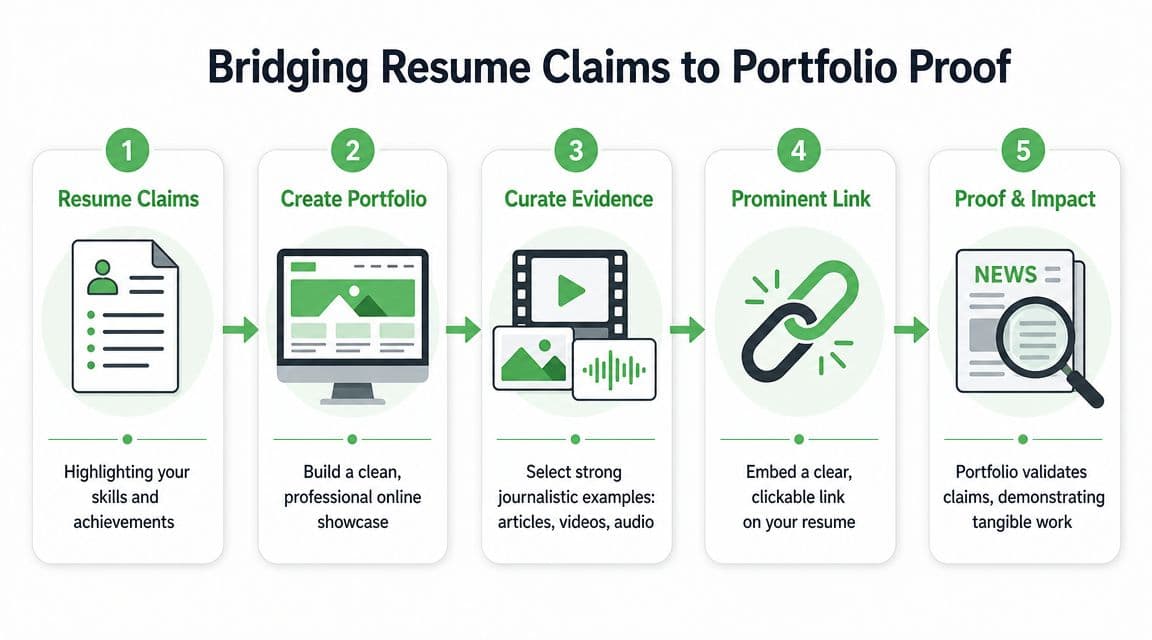
Put the portfolio link where no one can miss it
Your portfolio link belongs in the contact block at the top. Not buried at the bottom. Not hidden in a PDF annotation. Right at the start.
If you don't have a polished site yet, keep it simple. A clear home page, a short bio, selected clips, and contact information are enough. If you want a low-friction model, this guide to simple one-page websites is a practical way to think about structure without overbuilding.
Link proof inside the experience section
Many applicants fail to capitalize on available advantages.
Don't just write:
- Produced weekly podcast segments
Write something closer to:
- Produced recurring podcast segments, with selected portfolio links to final audio, episode notes, and transcript samples
Don't just write:
- Built data visualizations for investigations
Write:
- Reported and built data-driven story assets, with linked charts, cleaned datasets, and supporting methodology notes
For specialized roles, showing outputs matters more than asserting competence. Columbia's guidance specifically points toward tools like SQL, Python, and OpenRefine, but the practical lesson is broader. If you say you can do data journalism, show dashboards, charts, or cleaned datasets rather than relying on the claim alone, as discussed in the earlier Columbia guidance.
Multimedia evidence that actually helps
The best supporting assets are easy to open and quick to judge. Useful examples include:
- Article clips: Pick work that shows range or depth, not just publication logos.
- Video packages: Link to published segments with a short note on your role.
- Audio work: Include the final piece and, where appropriate, a transcript.
- Data outputs: Dashboards, charts, notebooks, cleaned datasets.
- Accessibility files: SRT or VTT captions when they demonstrate production completeness.
A hiring editor is more likely to trust one cleanly presented proof asset than five broad claims.
If you work with video, transcripts can do double duty. They make your clips searchable and easier to review quickly. Journalists who want that evidence on hand can use a transcription workflow and export assets like TXT, SRT, or VTT. One option is Vatis Tech, which transcribes audio or video and exports editable transcript and caption formats. If you need the process itself, this guide on how to transcribe a video is the useful starting point.
Curate, don't dump
A portfolio is not your entire internet footprint. It's your selected evidence locker.
Choose work that proves the specific case you're making:
- For a beat reporter role, lead with source-heavy reporting and clean writing.
- For a video role, lead with scripts, edits, and final packages.
- For a hybrid role, mix bylines with newsletters, explainers, clips, and transcript-backed media.
The point is speed. Your resume should make a claim in one line. Your portfolio should verify it in one click.
Tailoring Your Resume for Different Journalism Roles
A generic resume usually signals generic interest. Editors notice.
The strongest resumes for journalists start from a master document, then shift emphasis depending on the role. Same career, different framing. A metro editor, a data editor, and an audience director won't scan for the same clues.
What changes by role
Here's the practical difference.
| Role target | What to emphasize | What to downplay |
|---|---|---|
| Beat reporter | Sourcing, reporting range, clean chronology, strong clips | Broad software lists that don't connect to reporting work |
| Broadcast producer | Rundowns, scripting, booking, timing, video or control room workflow | Print-only clip emphasis unless it supports the role |
| Data journalist | SQL, Python, OpenRefine, cleaned datasets, charts, methodology | Generic claims about “research skills” |
| Newsletter or audience role | Audience growth, conversion rates, packaging, headline testing, recurring publication ownership | Resume bullets built only around bylines |
| Multimedia journalist | Shooting, editing, scripting, publishing across platforms | Long text-heavy bullets with no linked proof |
The hard part for hybrid roles is metric choice. Standard advice often centers on traditional reporting outputs, but newer newsroom jobs blend journalism with distribution, platform strategy, and audience development. That's why the more useful approach is translating platform-specific work into newsroom value, especially for roles like newsletter editor or audience engagement writer, as discussed in this Indeed guide to journalism resumes.
Re-sequence bullets, don't rewrite your life story
Tailoring usually doesn't require a full rebuild. It requires reordering.
If you're applying for a newsletter role, the bullet about writing homepage briefs may matter less than the one about shaping recurring audience-facing content. If you're applying for a data role, move technical workflow bullets higher and trim general reporting language that any candidate could claim.
A useful editing pass looks like this:
- Start with the job description: Mark the recurring verbs and tools.
- Match your evidence: Pull forward bullets and skills that align with those needs.
- Cut distractions: If a line doesn't strengthen fit, remove it.
- Change clip order: Your best evidence for this specific role should appear first in the linked portfolio too.
Don't force a false identity
Tailoring doesn't mean pretending to be something you're not.
If you're a strong general assignment reporter applying for an audience role, don't suddenly call yourself a growth strategist. Instead, show where your reporting intersected with packaging, reader service, recurring formats, or platform-aware writing. That's credible. Editors can work with credible.
Frequently Asked Questions About Resumes for Journalists
How should I present freelance or stringer work?
Group it cleanly. If you've published across several outlets, you can use one umbrella entry such as Freelance Reporter or Independent Journalist, then list selected clients or publications beneath it. Keep the bullets focused on recurring beats, formats, and outputs rather than making it look like a scattered list of one-off assignments.
What should I do about employment gaps?
Don't turn the resume into a confession. If the gap included relevant work such as freelancing, coursework, independent reporting, newsletter writing, or portfolio building, represent that clearly. If it was a true break, keep the chronology honest and let your current evidence do the heavy lifting.
I'm changing careers into journalism. What belongs on the resume?
Keep only the prior experience that strengthens your journalism case. Research, interviewing, public records work, editing, subject-matter expertise, production, analytics, and writing all transfer well when framed properly. Then add clips, self-initiated reporting, published commentary, or multimedia samples so the transition doesn't read as hypothetical.
Should I include every clip I've published?
No. Curate aggressively. A hiring editor wants selected proof, not a full archive. Lead with the work that best matches the opening.
Do student media roles count?
Absolutely, if they show real reporting, editing, production, or publishing responsibility. Treat them seriously. Label them clearly. Write the bullets with the same standards you'd use for professional newsroom work.
Is a cover letter still worth it?
Yes, when it adds context your resume can't carry on its own. Use it to explain fit, not to repeat the document line by line.
If your reporting process includes recorded interviews, audio cuts, video packages, or transcript-heavy workflows, Vatis Tech can help you turn raw material into searchable transcripts, captions, and supporting assets you can use in your portfolio and application materials. That's useful when your strongest proof isn't just a byline, but the multimedia work behind it.